

Studying abroad is an exciting opportunity. It gives you the chance to earn an internationally recognised qualification, experience a different culture, meet people from different backgrounds and develop skills that can shape your future career.
However, getting ready to study in another country involves much more than choosing a university and booking a flight. There are several important things you need to put in place before leaving your home country. This study abroad checklist is designed to help prospective international students understand what they need to do before travelling.
If you are planning to study in the UK, Canada, Australia, Germany, Spain, New Zealand, South Korea, China or another destination, proper preparation can make a significant difference to your experience. You need to consider university admission requirements, tuition fees, proof of funds, visa applications, accommodation, health insurance and travel arrangements. Missing an important document or overlooking a deadline could delay your plans, so it is better to organise everything early.
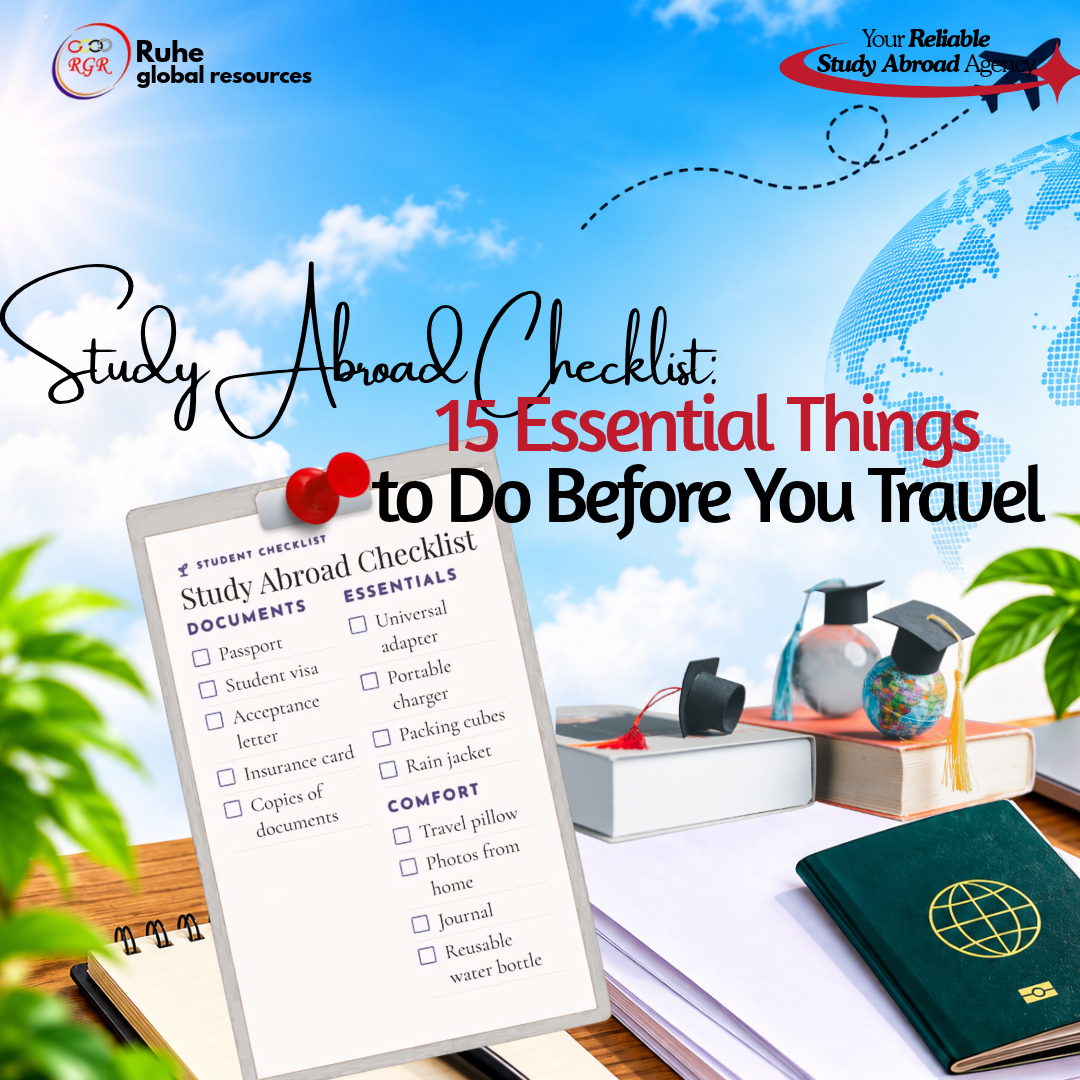
Here is a study abroad checklist to help you organise your plans, prepare the necessary documents and avoid unnecessary complications along the way
Study Abroad Checklist: Everything You Need to prepare Before Studying Overseas
1. Start Planning Your Study Abroad Journey Early:
One of the biggest mistakes prospective international students make is waiting until the last minute before preparing for their studies overseas. The process involves different stages, and some take longer than others.
1. University application
2. Document verification
3. Admission decisions
4. Visa processing, and all require sufficient time.
Starting early gives you room to research your options, compare universities and prepare the necessary documents without rushing through important decisions.
Ideally, begin researching your options several months before your intended intake. Some universities have multiple admission periods throughout the year, while others accept applications within specific deadlines. You should also consider how long it might take to obtain academic documents, complete an English language test, secure financial support and receive a visa decision. Creating a personal timeline will help you keep track of each stage and understand what needs your attention.
2. Choose Your Destination, Course and Institution
Before applying to any university, think carefully about what you want to study and where you would like to study. Your preferred destination should not be based solely on what is popular among other students. Consider your academic background, career interests, financial situation, preferred language of instruction and long-term educational goals.
For example, students interested in technology, engineering, business, healthcare or other specialised fields may find suitable programmes in several countries. Canada, Australia, Germany, Spain, New Zealand and the UK all offer different educational opportunities, but their admission requirements, tuition fees and student visa conditions are not the same.
Research the institutions offering your preferred course. Check whether the university is recognised, whether the programme matches your academic qualifications and whether the course content supports your career plans. You should also investigate the university's location, available student support services, accommodation options and international student community.
A university should be a good academic and financial fit, not simply a name that sounds impressive. Take your time to compare your options before making a decision.
3. Understand the Academic Requirements
Your academic qualifications play an important role in your study abroad application. Universities need to establish that you have the educational background required for your chosen programme. The qualifications accepted will depend on the institution, level of study and course you intend to pursue.
For undergraduate admission, you may need your secondary school certificates and examination results. For postgraduate programmes, universities commonly request your bachelor's degree certificate, academic transcripts and other supporting documents. Some professional or specialised courses may have additional requirements, such as relevant work experience, professional registration or prerequisite subjects.
Do not assume that the requirements for one university will automatically apply to another. Even universities in the same country can have different admission criteria. Read the course information carefully and contact the admissions team if you are unsure whether your qualifications meet the entry requirements.
4. Prepare Your Academic and Language Documents
Before submitting an application, gather your academic documents and make sure the information is clear and accurate. Depending on your educational background and chosen institution, you may need:
1.Secondary school certificates and examination results.
2. Bachelor's degree certificates, where applicable.
3. Official academic transcripts.
4. Postgraduate certificates, if applicable.
5. Curriculum vitae (CV), particularly for certain postgraduate programmes.
6. Personal statement or statement of purpose.
7. Letters of recommendation.
8. Evidence of relevant professional experience, where required.
You may also need to demonstrate your English language ability through an approved test such as IELTS, TOEFL or another examination accepted by your chosen institution. Some universities have their own language requirements or exemptions, so confirm the accepted tests and minimum scores before registering for an examination.
If your programme is taught in another language, you may need to provide evidence of proficiency in that language. For example, some German-taught programmes require German language qualifications.
Check that your name, date of birth and other personal details are consistent across your documents. If there are differences in spelling or other information, find out how to address them before submitting your application. Having your documents properly arranged can make the admission process much easier.
5. Plan Your Study Abroad Budgets
Studying overseas requires financial preparation. Even if you receive admission into your preferred university, you still need to consider whether you can comfortably manage the cost of studying and living in your destination country.
Your budget should cover more than tuition fees. Think about accommodation, feeding, transportation, visa application fees, health insurance, flights, study materials and other personal expenses. Some costs must be paid before travelling, while others will continue throughout your studies.
For students applying from Nigeria, it is also important to consider exchange rate fluctuations. The value of the naira against the currency of your destination can affect how much you need to pay for tuition and living expenses. Avoid making financial plans based on outdated exchange rates or estimates that do not reflect current costs.
6. Calculate Tuition Fees and Explore Scholarships
Start by checking the official tuition fees published by your chosen university. Find out whether the fees are charged annually, per semester or for the entire programme. You should also ask about application fees, acceptance deposits, payment deadlines and whether instalment arrangements are available.
Next, research the cost of living in your intended destination. Living in a major city may be more expensive than studying in a smaller town. Accommodation, food, transport and other daily expenses can vary considerably depending on your location and lifestyle.
Scholarships and other financial support may help reduce the cost of studying abroad. Some universities provide merit-based scholarships, while others offer financial assistance to international students who meet specific eligibility requirements. There may also be funding opportunities offered by governments, educational organisations or private institutions.
When researching scholarships, pay attention to the application deadline, eligibility criteria, academic requirements and amount covered. Some scholarships cover only part of the tuition fees, while others may provide additional support for accommodation or living expenses.
Never assume that receiving an admission offer automatically means you have received a scholarship. Confirm the award directly with the institution and obtain written details of the financial support available.
7. Complete Your University Application
Once you have selected a suitable course and confirmed that you meet the entry requirements, the next step is to complete your university application.
Most universities allow international students to apply through their official websites or recognised application platforms. Follow the instructions carefully and provide accurate information about your academic history, personal details and previous education.
Before submitting your application, review all the information you have entered. Check that your documents are uploaded in the correct format and that no required section has been left incomplete. If an application requires an application fee, confirm the accepted payment methods and make sure you keep evidence of payment.
8. Prepare Your Personal Statement and References

Your personal statement or statement of purpose gives the university an opportunity to understand your motivation for choosing a particular course. It should explain your academic interests, relevant experience, reasons for selecting the programme and how the qualification relates to your future goals.
Avoid submitting a generic statement that could apply to any course or university. Instead, explain why the programme interests you and what you hope to gain from the experience. Where relevant, discuss academic projects, professional achievements, volunteering or practical experiences that demonstrate your suitability.
Some universities also request academic or professional references. Choose referees who can provide meaningful information about your abilities, achievements and potential. Give them enough time to prepare their recommendations and ensure that their contact information is correct.
After submitting your application, monitor your email regularly. Universities may request additional documents, invite you for an interview or provide updates about your application. Respond to such requests promptly and keep copies of all important communication.
Once you receive an offer, read the conditions carefully. A conditional offer means you must meet certain requirements before your admission can be confirmed, while an unconditional offer indicates that the stated academic conditions have been satisfied. Follow the university's instructions regarding acceptance and payment deadlines.
9. Organize Your Student Visa Documents
Securing admission is an important milestone, but you must also obtain the appropriate immigration permission before travelling to study, where required. Student visa requirements differ from one country to another, and the documents you need will depend on your nationality, course, institution and personal circumstances.
For Nigerian students, it is particularly important to consult the official immigration website and the relevant embassy or visa application centre for the destination country. Do not depend entirely on information shared on social media or advice from someone who applied several years ago. Immigration policies and application procedures can change.
10. Understand Visa Requirements and Prepare Supporting Documents

Before starting your visa application, identify the specific visa category that applies to your programme. Find out when you can apply, how much the application costs, whether you need to attend a biometric appointment and what supporting evidence must be submitted.
Common student visa documents may include:
1. A valid international passport.
2. University admission or acceptance letter.
3. Visa application form.
4. Recent passport photographs, where required.
5. Evidence of sufficient financial resources.
6. Proof of tuition fee payment, where applicable.
7. Academic certificates and transcripts.
8. English language test results, where required.
9. Health or medical examination documents, where required.
10. Evidence of accommodation, where required.
11. Additional supporting documents requested by the immigration authority.
For example, UK Student visa applicants generally need a Confirmation of Acceptance for Studies (CAS) from their education provider and may need to demonstrate that they have sufficient funds. Canada's study permit requirements include enrolment at a designated learning institution and evidence of financial capacity. Germany also requires proof of admission and sufficient financial resources.
These are examples rather than a universal document list. Requirements can differ according to individual circumstances and may change over time. Always use the official immigration checklist for your particular application.
You should also check whether you need a medical examination, tuberculosis screening or police clearance certificate. If any documents require certified translation, legalisation or apostille, arrange this before your application deadline.
Submit genuine and accurate information throughout the process. Do not use false financial documents, altered certificates or misleading information. Such actions can seriously affect your application and future immigration opportunities.
11. Arrange Accommodation and Health Insurance
Finding somewhere suitable to live is another important part of preparing for your studies abroad. Your accommodation will influence your comfort, daily expenses and overall student experience.
Many universities provide on-campus accommodation or work with approved student housing providers. You can also explore private student residences, shared apartments or other suitable rental arrangements. Before making a payment, confirm the location, rental terms, facilities, deposit requirements and distance from your university.
If possible, choose accommodation that gives you convenient access to your campus, public transportation, supermarkets and other essential facilities. Consider whether the rent includes utilities such as electricity, heating, water and internet. These additional expenses can affect your monthly budget.
Be careful when booking accommodation online. Verify that the property and provider are genuine before sending money. Avoid paying deposits to individuals or organisations you cannot independently confirm. Ruhe Global Resources can help you find suitable accommodation that fits your budget and preferences.
Health insurance is equally important. Some countries require international students to have approved health insurance before they can obtain a visa or register at their institution. Other destinations may have specific healthcare arrangements for international students.
Find out what type of coverage is required, when the policy must begin and which medical services it includes. Do not assume that ordinary travel insurance will automatically satisfy a country's student health insurance requirements. Confirm the details with your university and the relevant authorities.
12. Book Your Flight and Prepare for Travel
Once your admission and immigration arrangements are in place, you can begin organising your travel. Your flight should be planned around your university's official arrival instructions, course registration dates and any compulsory orientation activities.
Compare different airlines, flight routes, baggage allowances and ticket conditions before making a booking. Some tickets may have restrictions on changes or refunds, so read the terms carefully. If your university recommends arriving on a particular date, try to arrange your travel accordingly.
Avoid booking a flight that will cause you to miss registration, accommodation check-in or other important university activities. You should also allow enough time for airport procedures, possible delays and the journey from the airport to your accommodation.
13. Organise Your Travel Documents and Pack the Essentials
Before leaving home, arrange all your important travel documents in one secure folder. Keep original documents and accessible digital copies where possible.
Your hand luggage should contain the documents you may need during check-in, transit and arrival. These may include your passport, visa or immigration approval, admission letter, accommodation details, financial evidence and relevant university correspondence.
For your luggage, prioritise items you will genuinely need during your first few weeks. Depending on your destination and personal circumstances, consider packing:
1. Suitable clothing for the destination's climate.
2. Comfortable shoes and everyday essentials.
3. Personal hygiene products.
4. Prescription medication in its original packaging, alongside any required prescription or medical documentation.
5. Chargers, adapters and essential electronic devices.
6. Important academic documents.
7. A small amount of accessible money for immediate expenses.
8. Check the airline's baggage allowance and your destination country's customs restrictions before packing. Certain food products, medicines and other items may be restricted or require declaration.
It is also a good idea to carry emergency contact information, your accommodation address and your university's international student support details. Having these details readily available can be helpful if you experience unexpected travel difficulties.
14. Prepare for Life in your New Country
Moving abroad for education involves adjusting to a new environment. You may experience different weather conditions, food, communication styles, transportation systems and cultural practices. Preparing yourself before departure can make the transition easier.
Research your destination's customs and everyday expectations. Learn about public transportation, local safety guidelines, emergency contact numbers and the general cost of living. If the local language differs from your own, learning a few basic expressions can also help you communicate more confidently.
You should also familiarise yourself with the academic environment. Teaching methods, classroom participation, assessment systems and student responsibilities may differ from what you are used to. Some institutions place considerable emphasis on independent research, group projects, presentations and practical learning.
15. Understand Student Life and Plan Your Arrival
Before travelling, check whether your university has an international student orientation programme. These activities can introduce you to the campus, academic services, student societies and important university policies.
Find out how to register for your course, obtain your student identification card and access your university email account. You may also need to complete an enrolment process, attend an induction session or provide original academic documents.
Plan how you will get from the airport to your accommodation. Research available transport options and keep the address and contact details of your accommodation provider accessible.
It may also be useful to research how to open a local bank account, obtain a local SIM card and access essential services after arrival. The exact procedures will depend on the country and your immigration status.
Remember that settling into a new country takes time. Give yourself room to adjust, meet new people, ask questions and become familiar with your surroundings. Your university's international student support team can be a useful source of guidance when you need assistance.
Common Study Abroad Mistakes to Avoid
Even with a good plan, certain mistakes can make the study abroad process more difficult than it needs to be. Being aware of them early can help you make better decisions and protect the time and money you invest in your education.
1. One common mistake is applying to universities without checking their admission requirements. Students sometimes choose a course based on its popularity without confirming whether their qualifications meet the entry criteria. This can lead to unnecessary application fees, delays and disappointment. Always review the official course requirements before submitting an application.
2. Underestimating the total cost of studying overseas. Tuition fees are only one part of the expense. Accommodation deposits, visa fees, flights, insurance, feeding and daily transportation all need to be included in your financial plan. Prepare a realistic budget and leave room for unexpected expenses.
3. Delay of visa applications until very close to the intended travel date. This can create unnecessary pressure, particularly when additional documents or appointments are required. Check application timelines early and submit your application when you are eligible to do so.
4. Using unverified admission agents, fake scholarship offers and accommodation scams. Always verify university representatives, payment instructions and official communication channels. Never hand over original documents or make payments without understanding who you are dealing with.
5. Avoid submitting incomplete or inaccurate information. Review every form, check your documents and ensure that the information you provide is truthful. A careful application is much better than a rushed one.
In Conclusion, preparing to study abroad is a process that requires careful planning, patience and attention to detail. From selecting the right university and preparing your academic documents to arranging finances, securing your student visa and booking accommodation, every stage plays an important role in getting you ready for your international education journey.
You do not have to figure everything out on your own. Working with an experienced study abroad agency like Ruhe Global Resources can help you understand your options, identify suitable universities and receive guidance throughout the admission and visa application process.
At Ruhe Global Resources, we understand that choosing to study overseas is an important decision. Our team helps prospective students explore study opportunities and navigate the different stages of their international education plans.
If studying abroad is part of your next big move, start preparing today. The earlier you get organised, the better prepared you will be to take the next step towards your academic goals.